

European Southern Observatory Top 100 Images
1 The hidden fires of the Flame Nebula
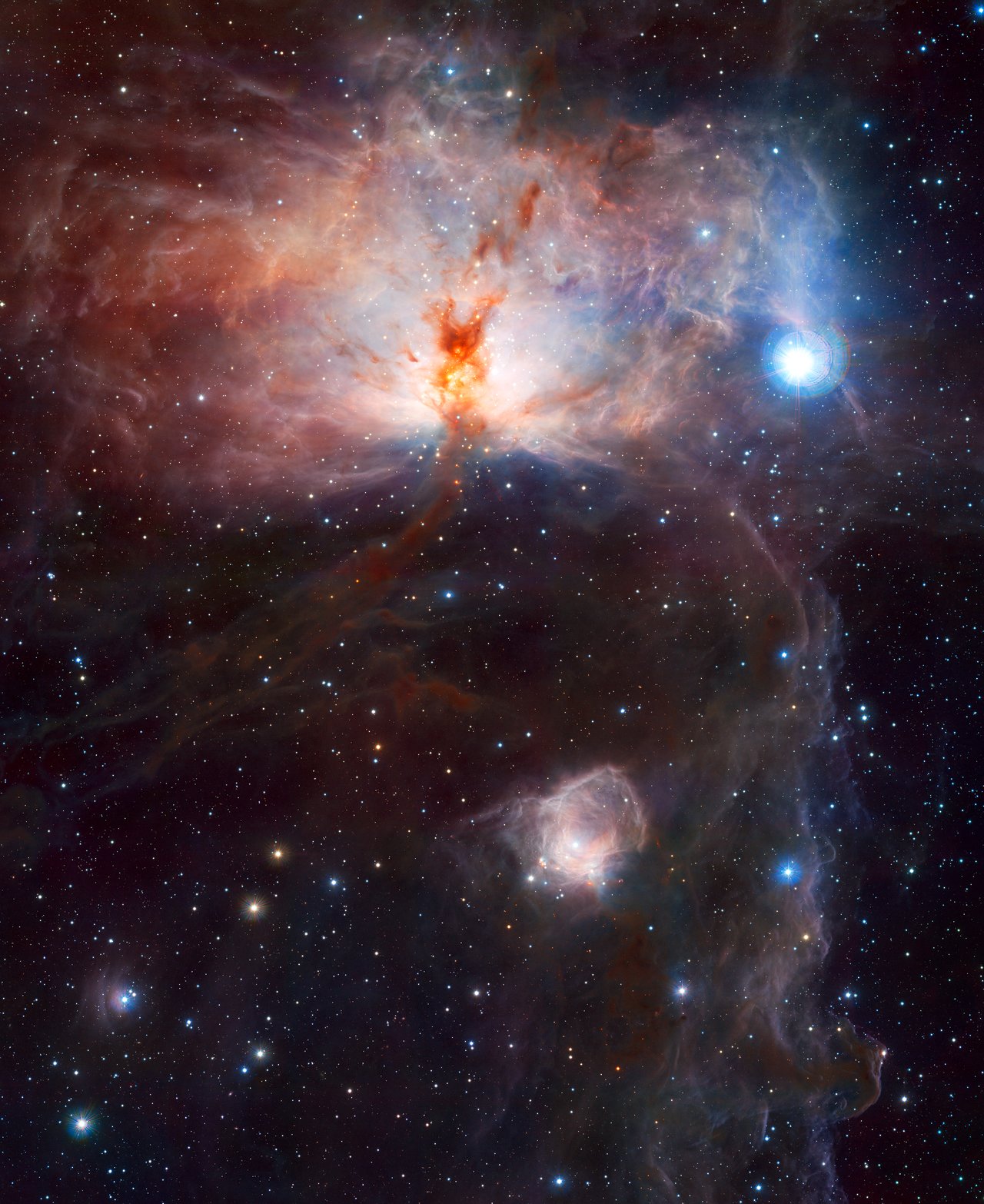
This image, the first to be released publicly from VISTA, the world’s largest survey telescope, shows the spectacular star-forming region known as the Flame Nebula, or NGC 2024, in the constellation of Orion (the Hunter) and its surroundings. In views of this evocative object in visible light the core of the nebula is completely hidden behind obscuring dust, but in this VISTA view, taken in infrared light, the cluster of very young stars at the object’s heart is revealed. The wide-field VISTA view also includes the glow of the reflection nebula NGC 2023, just below centre, and the ghostly outline of the Horsehead Nebula (Barnard 33) towards the lower right. The bright bluish star towards the right is one of the three bright stars forming the Belt of Orion. The image was created from VISTA images taken through J, H and Ks filters in the near-infrared part of the spectrum. The image shows about half the area of the full VISTA field and is about 40 x 50 arcminutes in extent. The total exposure time was 14 minutes.
2 Portrait of a Dramatic Stellar Crib
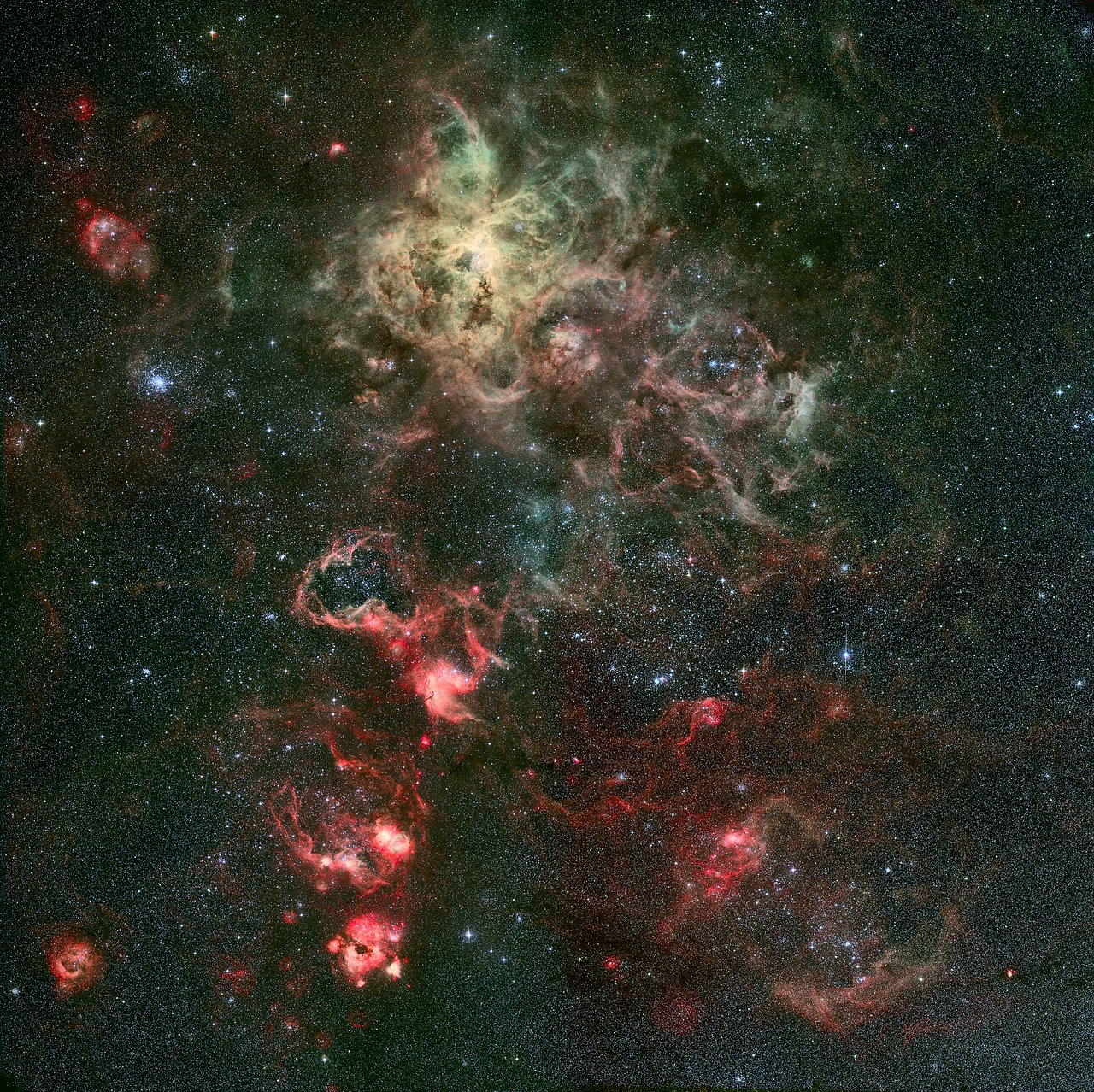
One square degree image of the Tarantula Nebula and its surroundings. The spidery nebula is seen in the upper-centre of the image. Slightly to the lower-right, a web of filaments harbours the famous supernova SN 1987A (see below). Many other reddish nebulae are visible in the image, as well as a cluster of young stars on the left, known as NGC 2100.Technical information: the image is based on observations carried out by Joao Alves (Calar Alto, Spain), Benoit Vandame and Yuri Beletski (ESO) with the Wide Field Imager (WFI) at the 2.2-m telescope on La Silla. These data consist of a 2x2 WFI mosaic in the B- and V-bands, and in the H_ and [OIII] narrow bands. The data were first processed with the ESO/MVM pipeline by the Advanced Data Products (ADP) group at ESO. The spectacular colour composite image resulting from these observations was made by Bob Fosbury (ST-ECF).
3 The Helix Nebula
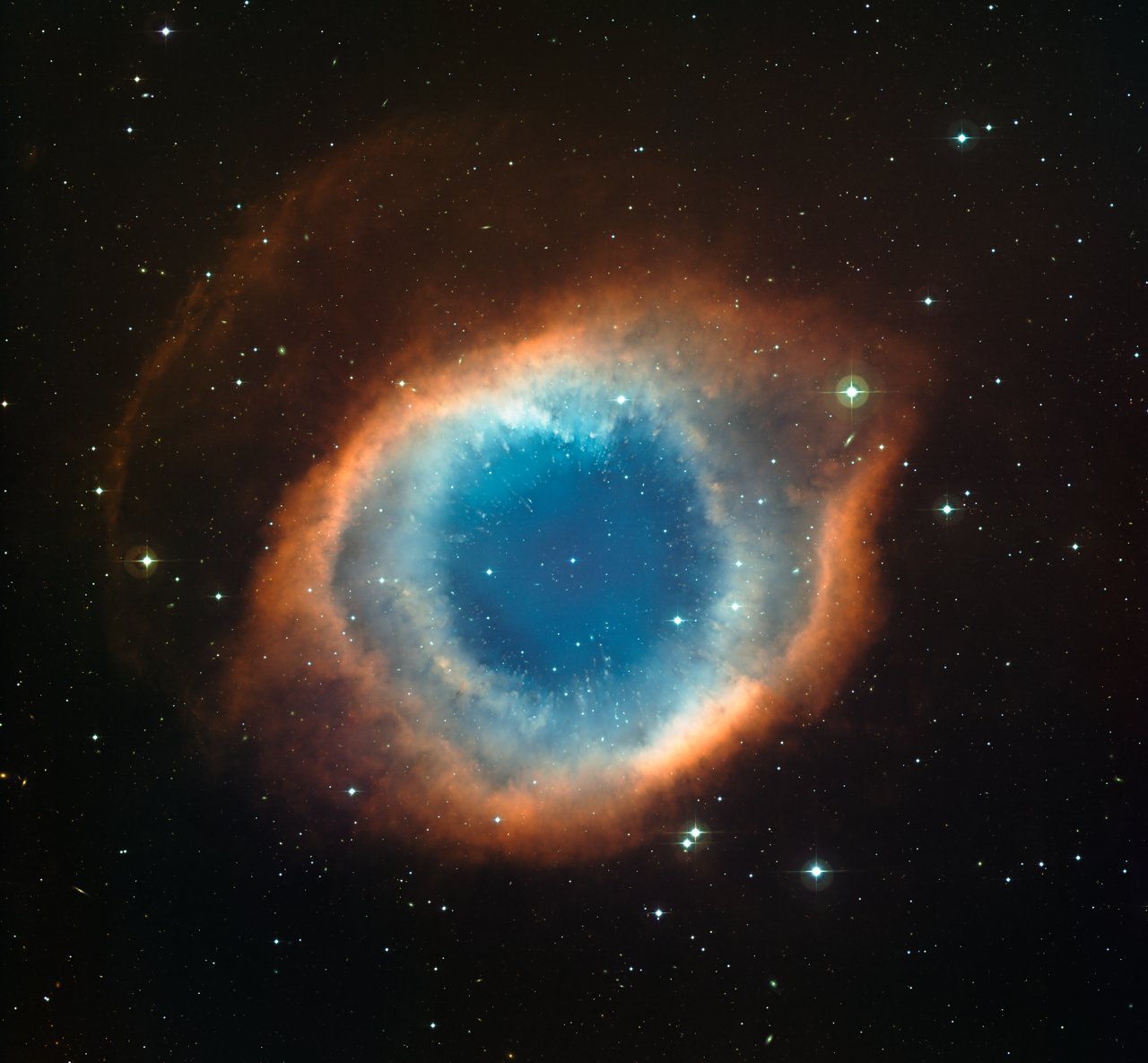
This colour-composite image of the Helix Nebula (NGC 7293) was created from images obtained using the the Wide Field Imager (WFI), an astronomical camera attached to the 2.2-metre Max-Planck Society/ESO telescope at the La Silla observatory in Chile. The blue-green glow in the centre of the Helix comes from oxygen atoms shining under effects of the intense ultraviolet radiation of the 120 000 degree Celsius central star and the hot gas. Further out from the star and beyond the ring of knots, the red colour from hydrogen and nitrogen is more prominent. A careful look at the central part of this object reveals not only the knots, but also many remote galaxies seen right through the thinly spread glowing gas.
This image was created from images through blue, green and red filters and the total exposure times were 12 minutes, 9 minutes and 7 minutes respectively.
http://www.eso.org/public/images/archive/top100/
via![[info]](http://l-stat.livejournal.com/img/userinfo.gif?v=1) const
const
This image, the first to be released publicly from VISTA, the world’s largest survey telescope, shows the spectacular star-forming region known as the Flame Nebula, or NGC 2024, in the constellation of Orion (the Hunter) and its surroundings. In views of this evocative object in visible light the core of the nebula is completely hidden behind obscuring dust, but in this VISTA view, taken in infrared light, the cluster of very young stars at the object’s heart is revealed. The wide-field VISTA view also includes the glow of the reflection nebula NGC 2023, just below centre, and the ghostly outline of the Horsehead Nebula (Barnard 33) towards the lower right. The bright bluish star towards the right is one of the three bright stars forming the Belt of Orion. The image was created from VISTA images taken through J, H and Ks filters in the near-infrared part of the spectrum. The image shows about half the area of the full VISTA field and is about 40 x 50 arcminutes in extent. The total exposure time was 14 minutes.
2 Portrait of a Dramatic Stellar Crib
One square degree image of the Tarantula Nebula and its surroundings. The spidery nebula is seen in the upper-centre of the image. Slightly to the lower-right, a web of filaments harbours the famous supernova SN 1987A (see below). Many other reddish nebulae are visible in the image, as well as a cluster of young stars on the left, known as NGC 2100.Technical information: the image is based on observations carried out by Joao Alves (Calar Alto, Spain), Benoit Vandame and Yuri Beletski (ESO) with the Wide Field Imager (WFI) at the 2.2-m telescope on La Silla. These data consist of a 2x2 WFI mosaic in the B- and V-bands, and in the H_ and [OIII] narrow bands. The data were first processed with the ESO/MVM pipeline by the Advanced Data Products (ADP) group at ESO. The spectacular colour composite image resulting from these observations was made by Bob Fosbury (ST-ECF).
3 The Helix Nebula
This colour-composite image of the Helix Nebula (NGC 7293) was created from images obtained using the the Wide Field Imager (WFI), an astronomical camera attached to the 2.2-metre Max-Planck Society/ESO telescope at the La Silla observatory in Chile. The blue-green glow in the centre of the Helix comes from oxygen atoms shining under effects of the intense ultraviolet radiation of the 120 000 degree Celsius central star and the hot gas. Further out from the star and beyond the ring of knots, the red colour from hydrogen and nitrogen is more prominent. A careful look at the central part of this object reveals not only the knots, but also many remote galaxies seen right through the thinly spread glowing gas.
This image was created from images through blue, green and red filters and the total exposure times were 12 minutes, 9 minutes and 7 minutes respectively.
http://www.eso.org/public/images/archive/top100/
via
const
cold
cabaret voltaire - the single